Schooling Ideas from Chesterton
Something is plaguing modern schooling. Whether you are a teacher in a classroom, or a student sitting at a desk, you have probably sensed that learning is more passive than it should be. You know that learning should be a pursuit of knowledge and virtue, but that isn’t what you see when you peer into the typical modern classroom. Or, maybe you’re in a school that knows how to achieve this and engage students. The staff morale is excellent at these schools. If you’re there, then that is wonderful!
There is a quote circulating from Jacques Barzun: “Schools can teach, but they can’t educate.”
If this is true, then what is education? Barzun’s quote implies that we once knew what constituted an education. How can we rediscover it?
A Different Kind of Education
In Josef Pieper’s 2009 work, Leisure: The Basis of Culture, readers go back to the origins of our word school. School is the name for an institution of education and learning. Tracing the word from the English to the Latin form of school, one arrives at scola. Continuing back in history to the Greeks, one finds the word scholé . Scholé is the Greek word for leisure. Leisure is quite a different idea from the idea moderns associate with school. Yet, the Greek name for the institutions of education and learning means “leisure.”’
If leisure is school and school is leisure, then what is leisure?
Leisure, as defined by Pieper, is a state of mind that leads to human flourishing. The modern idea attached to leisure is free time. But leisure is not free time. Rather, it is a serene contemplation and to engaging in culture and the true, good, and beautiful ideas in the world. Relationship to the divine, peace with one’s existence, and receptivity to cultural enrichment is essential to human fulfillment.
G.K. Chesterton (1874-1936) lived as someone who embraced a “law of leisure”, as he called it. His law of leisure is a mentality of openness and receptivity, accompanied by wonder, gratitude, expectancy, grace, and attentiveness to the mundane with a willingness to expect something good.
Who Was Chesterton?
G.K. Chesterton was alive in the late 1800s and early 1900s. His career took off around the turn of the century, and he is known for his thousands of essays, hundreds of books, many poems and short stories, and several plays.
Although he was educated very well in his formative years, he did not earn a college degree. Over the course of his 62 years, he became a voice for Christian faith amid a growing secular culture. (C.S. Lewis became a Christian after reading Chesterton’s The Everlasting Man.)
Where Do We Find Truth?
Chesterton knew what it was like to experience life’s tremendous questions. His boyhood was filled with these questions. Over the course of his life, his mind was hammering out the answers. Nonetheless, he never reached a point of complete arrival. He knew that while he and the industrialized world in which he lived were discovering the truth that was always there, the truth was nothing new. There was nothing new under the sun, and these discoveries were part of an eternal philosophy, from a source external to himself.
If you, reader, adopt this idea that there is a mind behind the cosmos, an external source that imparts truth to human minds, then you begin to question the nature of truth. What is truth?
Two Truth-Bearing Faculties
Chesterton believed that there were two truth-bearing faculties: reason and the imagination. For the sake of philosophical consistency, this idea about reason and imagination did not originate with Chesterton. If it didn’t originate with Chesterton, did it originate with MacDonald? No. If it didn’t originate with MacDonald, did it originate with Coleridge? No. If it didn’t originate with Coleridge, did it originate with Burke? Perhaps further back, with Dante? Or could it have originated with Aquinas, or Augustine, or Plato?
My point is, the idea that the imagination and reason are two ways to carry the truth is nothing new under the sun.
They are two different things, however.
Reason’s tool is the argument. Imagination’s tool is creativity.
Reason is conditioned by space. Imagination can glimpse eternity.
Reason needs the body or a boundary. Imagination needs great, open spaces.
Both are truth-bearing faculties.
Captivate Students with Imagination and Wonder
What may be missing in a more modern education is the use of the imagination as a truth-bearing faculty to elicit wonder in students.
Did Chesterton do this in his own education of the mind? Absolutely. Even as an adult, he fed his imagination with truth-bearing myths, fairy tales, and paradoxes. He subscribed to the paradox of the mind’s life: a need for a use of the mind that could embrace the universe and reach upwards to God without losing its balance.
Imagination and reason balance one another in an education. They must go together, if we are to captivate students. Art, for example, cannot be created without any bounds or reference point. But art contains an element of freedom in the imagination.
One of Chesterton’s most famous quotes is, “Gratitude is happiness doubled by wonder.” Without wonder, one cannot fully embrace gratitude, which has many lasting benefits. Gratitude lets one feel more centered in life.
May we admire this Chesterton poem, written shortly after his emergence from a dark life period.
“Evening”
Here dies another day
During which I have had eyes, ears, hands
And the great world round me;
And with tomorrow begins another.
Why am I allowed two?
Will Students Find Gratitude at School?
Where will students find a way to express gratitude, in response to imagination and wonder?
How many hours a day are students in classes? Just for a moment each day, a math teacher could show how different patterns found in math are also present in nature (i.e., the Fibonacci Sequence/Golden Ratio). Wonder and gratitude, anyone?
Drawing from Chesterton’s ideas, schools can incorporate more imagination, wonder, and gratitude in their daily routines, and maybe school will start looking more like scholé.
About the Author
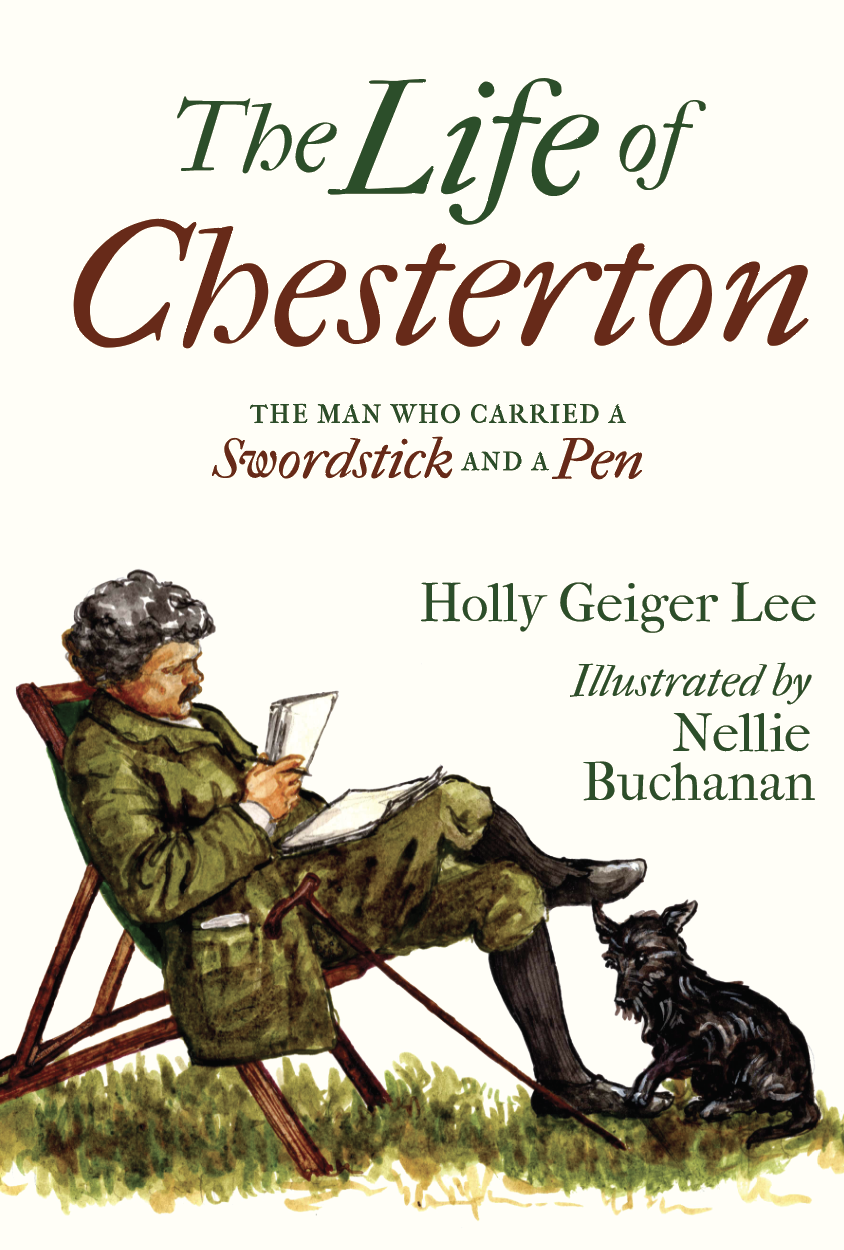
Holly Geiger Lee is the author a biography written for middle grades students on G.K. Chesterton.
The Life of Chesterton: The Man Who Carried a Swordstick and a Pen
by Holly Geiger Lee
Illustrator: Nellie Buchanan
Learning More About Chesterton or Reading Living Books?: Check out Holly’s YouTube Channel!
Find out more about Holly’s speaking and teaching opportunities over the past year here.